
Obstructive Sleep Apnea vs. Central Sleep Apnea: Two Conditions That Share a Name

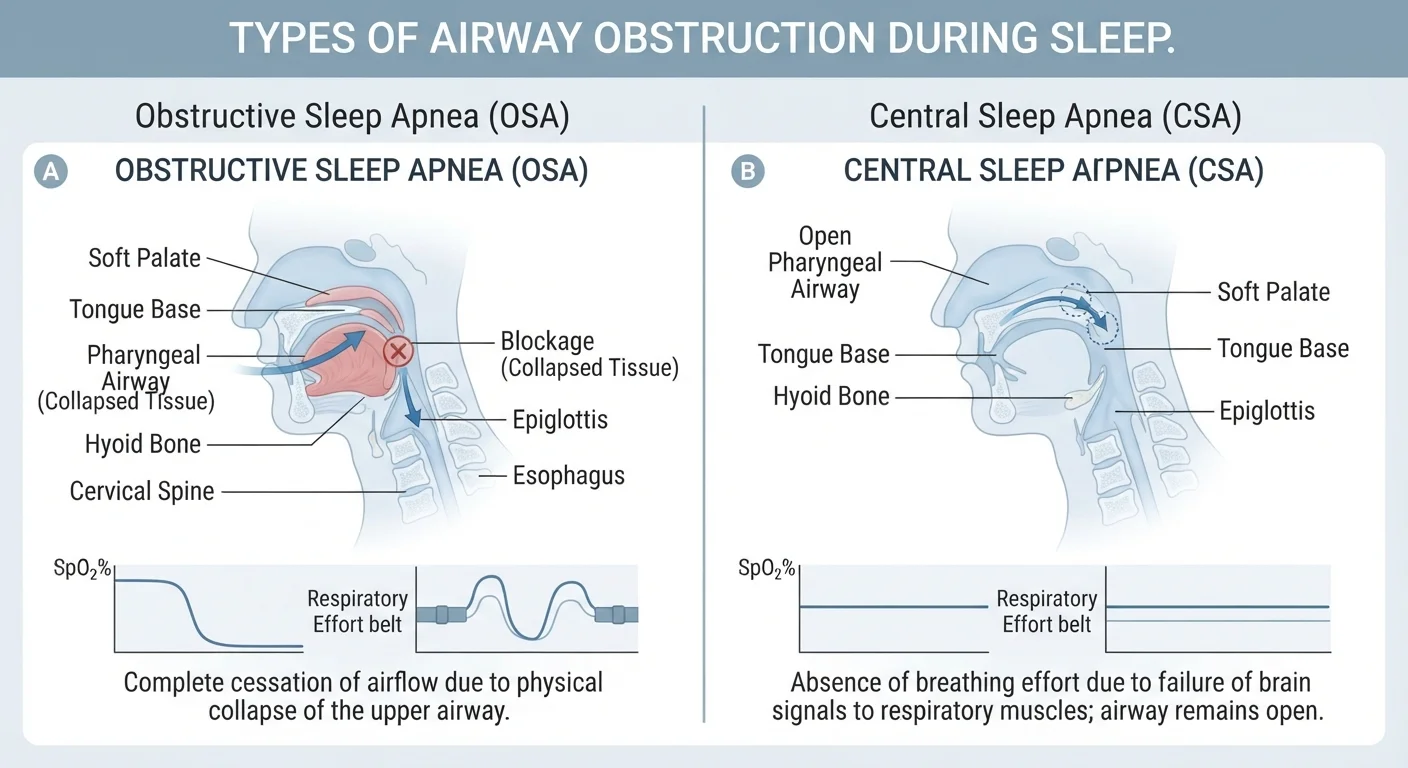
Photo: YetaWellness.com | Explore Trending Blogs editorial
Key Takeaways
- OSA is caused by physical airway obstruction; CSA is caused by faulty brain signaling to breathing muscles.
- OSA is far more prevalent, accounting for the large majority of sleep apnea diagnoses in the US.
- Both conditions fragment sleep and reduce blood oxygen, but their management strategies differ meaningfully.
- A formal sleep study (polysomnography) is required to accurately distinguish between OSA and CSA.
- CSA is often associated with underlying medical conditions such as heart failure or neurological disorders.
- Anyone experiencing symptoms of either condition should consult a qualified healthcare provider for evaluation.
The Same Name, Two Very Different Mechanisms
The term sleep apnea describes a condition where breathing repeatedly stops during sleep — but that shared label can be misleading. Obstructive Sleep Apnea (OSA) and Central Sleep Apnea (CSA) represent two distinct physiological problems that happen to share the same surface-level symptom: pauses in breathing. Understanding the underlying mechanism is essential, because it determines how the condition is identified and managed.
In OSA, the airway itself is the problem. During sleep, the muscles supporting the soft tissue of the throat relax, and in some people this causes the airway to partially or fully collapse. The body continues trying to breathe — chest and abdominal muscles still work — but airflow is blocked. In CSA, the airway is typically open, but the brain simply fails to send the appropriate signal to the muscles responsible for breathing. There is no effort made at all during the pause.
This distinction — effort without airflow versus no effort at all — is what clinicians look for during a diagnostic sleep study. Recognized sleep disorders like these are classified using precise criteria, and accurate diagnosis matters enormously for choosing an effective path forward.
| Criterion | Obstructive Sleep Apnea (OSA) | Central Sleep Apnea (CSA) |
|---|---|---|
| Primary cause | Physical airway collapse during sleep | Brain fails to signal breathing muscles |
| Breathing effort present? | Yes — effort continues despite blockage | No — no respiratory effort made |
| Prevalence | Very common; majority of apnea cases | Rare; often secondary to other conditions |
| Characteristic snoring | Frequently present and loud | Often absent or minimal |
| Common associations | Obesity, anatomical factors, age, sex | Heart failure, neurological disorders, opioids |
| Primary diagnostic tool | Polysomnography or home sleep test | Polysomnography (in-lab preferred) |
| First-line treatment | CPAP therapy | Treat underlying cause; ASV in some cases |
Prevalence, Risk Factors, and Who Is Affected
OSA is substantially more common. Research published through the American Academy of Sleep Medicine estimates that roughly 26% of adults between the ages of 30 and 70 in the United States have OSA, with many cases going undiagnosed. Risk factors include excess weight (particularly central obesity), anatomical features such as a large neck circumference or narrow jaw, nasal congestion, and age. Men are diagnosed at higher rates than women, though women's risk increases after menopause.
CSA is considerably rarer and tends to present differently. It is frequently associated with underlying medical conditions rather than occurring in isolation. Heart failure is one of the most well-established associations — a specific pattern called Cheyne-Stokes respiration, involving a cyclical crescendo-decrescendo breathing pattern, is recognized in a subset of heart failure patients. Neurological conditions, opioid use, and high-altitude exposure can also contribute to CSA. Because CSA is often secondary to another condition, addressing that underlying condition is typically central to its management.
~26%
US adults estimated to have OSA
Based on AASM-cited prevalence estimates for adults aged 30–70, with many cases remaining undiagnosed.
<1%
General population prevalence of CSA
CSA is significantly rarer than OSA in the general population, occurring more often alongside other medical conditions.
30–40%
Heart failure patients with CSA patterns
Studies suggest Cheyne-Stokes respiration, a CSA variant, is observed in a substantial subset of heart failure patients.
Symptom overlap exists — both conditions can cause excessive daytime sleepiness, frequent nighttime awakenings, and difficulty concentrating. However, the loud, disruptive snoring that often brings OSA to a bed partner's attention is less characteristic of CSA. Witnessed apneas — pauses in breathing observed by someone else — can occur with both.
Diagnosis and Management: Where the Paths Diverge
Neither condition can be reliably self-diagnosed. A formal sleep study — either an in-lab polysomnography or, in appropriate candidates for OSA, a home sleep apnea test — is required to distinguish between the two and to quantify severity. Polysomnography simultaneously measures airflow, respiratory effort, oxygen saturation, and brain activity, providing the data clinicians need to make an accurate determination.
For OSA, the most widely studied and commonly recommended treatment is Continuous Positive Airway Pressure (CPAP) therapy, which delivers a steady stream of air to keep the airway open during sleep. Positional therapy, weight management, oral appliances, and in some cases surgical interventions may also be considered depending on severity and individual circumstances.
Management of CSA is more complex and more individualized. While CPAP is sometimes used, certain CSA presentations respond better to Adaptive Servo-Ventilation (ASV) — a device that adjusts pressure in response to the patient's own breathing pattern. However, ASV is contraindicated in some patient populations, particularly those with certain types of heart failure, underscoring why working with a qualified sleep medicine specialist is essential. Treating the underlying condition — for example, optimizing heart failure management — is often a parallel and critical component of care.
This article is intended for general informational and educational purposes only and does not constitute medical advice. If you are experiencing symptoms that may relate to a sleep disorder, please consult a qualified healthcare provider for an evaluation tailored to your individual circumstances.
The content on this site is for informational purposes only and is not a substitute for professional advice. Always consult a qualified professional for guidance specific to your situation.