
Fast Metabolism vs. Slow Metabolism: What the Evidence Really Shows

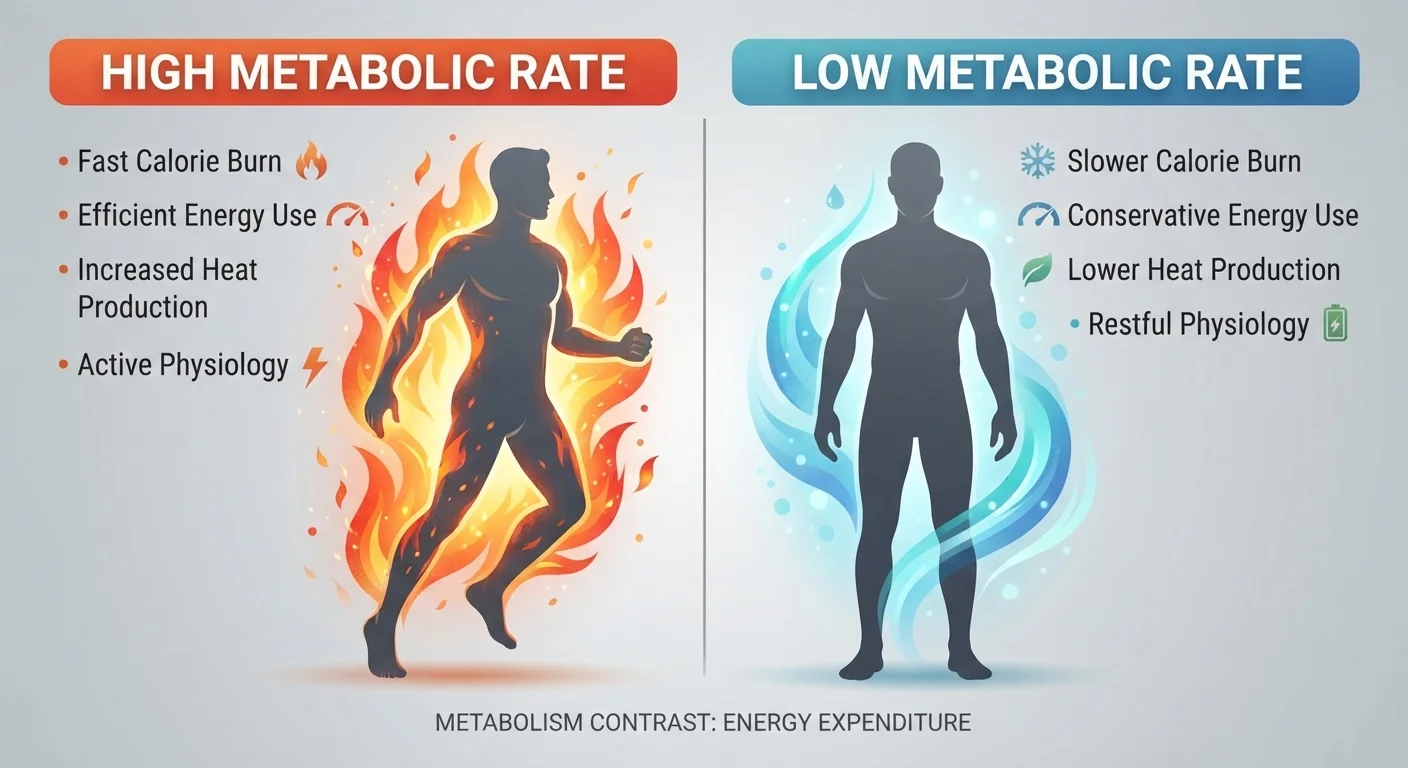
Photo: YetaWellness.com | Explore Trending Blogs editorial
Key Takeaways
- Metabolic rate differences between individuals exist but are smaller than popular belief suggests.
- Body composition - especially lean muscle mass - is the primary driver of resting metabolic rate.
- Genetics, age, hormones, and body size all influence metabolic speed, but are not destiny.
- Metabolic adaptation occurs in response to prolonged calorie restriction, reducing energy expenditure over time.
- Labeling yourself 'fast' or 'slow' metabolizer oversimplifies a complex, dynamic biological system.
What Do We Actually Mean by Metabolism?
Before comparing fast and slow metabolism, it helps to define the term precisely. Metabolism refers to all the biochemical processes your body uses to convert food and stored nutrients into usable energy. This includes everything from breathing and circulating blood to digesting food and repairing cells.
The most commonly cited figure is resting metabolic rate (RMR) - the number of calories your body burns at complete rest just to sustain basic functions. RMR accounts for roughly 60-70% of total daily energy expenditure for most adults. The remaining energy is spent on digestion (the thermic effect of food) and physical activity.
When people say someone has a "fast" or "slow" metabolism, they're typically referring to whether a person's RMR sits above or below average for their body size - though this distinction is far less clear-cut than popular culture implies. For a deeper look at how metabolic misconceptions spread, see our breakdown of common metabolism myths.
How Much Does Metabolic Rate Actually Vary Between People?
A landmark study published in Current Biology (Pontzer et al., 2021), tracking over 6,400 participants across 29 countries, found that when total energy expenditure is adjusted for body size and composition, individual variation is surprisingly modest - roughly plus or minus 26% around the average. That said, across the full population, meaningful differences do exist.
The largest single predictor of metabolic rate is lean body mass - primarily skeletal muscle. Muscle tissue is metabolically active, meaning it burns more energy at rest than fat tissue does. Two people of identical weight can have substantially different RMRs if one carries significantly more muscle.
| Criterion | Fast Metabolism | Slow Metabolism |
|---|---|---|
| Resting Metabolic Rate | Above average for body size | Below average for body size |
| Primary Driver | Higher lean muscle mass | Lower lean muscle mass |
| Hormonal Influence | Typically normal to elevated thyroid function | May involve reduced thyroid activity |
| NEAT Contribution | Often higher spontaneous activity | Often lower spontaneous activity |
| Susceptibility to Adaptation | Can still slow with prolonged restriction | More pronounced metabolic adaptation risk |
| Modifiability | Partially - muscle mass and activity matter | Partially - same modifiable levers apply |
Other documented influences include thyroid hormone levels, age, sex, and - to a lesser degree - genetics. However, research consistently shows that lifestyle-modifiable factors (particularly muscle mass preservation) have more practical impact than inherited metabolic speed alone.
The Biology Behind Metabolic Differences
Several biological mechanisms explain why some people expend energy more readily than others:
- Thyroid function: The thyroid gland produces hormones (T3 and T4) that regulate metabolic rate at the cellular level. Clinical conditions like hypothyroidism can genuinely slow metabolism, while hyperthyroidism can accelerate it.
- Non-exercise activity thermogenesis (NEAT): This refers to energy burned through everyday movement - fidgeting, posture maintenance, walking between rooms. Research suggests NEAT can vary by up to 2,000 calories per day between individuals, representing a far larger metabolic difference than RMR alone.
- Mitochondrial efficiency: Cells generate energy through mitochondria. Individual differences in mitochondrial density and efficiency influence how effectively fuel is converted to energy versus heat.
Importantly, metabolic rate is not fixed. It responds dynamically to circumstances. Prolonged calorie restriction, for example, triggers metabolic adaptation - a survival response in which the body reduces energy expenditure beyond what weight loss alone would predict. Learn more about why crash diets can slow metabolic rate over time.
Does Aging Slow Metabolism - And How Much?
Many people accept that metabolism slows steadily with age, but the evidence presents a more nuanced picture. The same large-scale Pontzer et al. research found that total energy expenditure remains relatively stable from roughly age 20 to 60, after adjusting for body composition changes. A more pronounced decline tends to appear after age 60.
This suggests that much of the perceived metabolic slowdown in middle age may be driven by gradual muscle loss (sarcopenia) and reduced physical activity rather than intrinsic metabolic decline. The aging metabolism involves more complexity than a simple slowdown.
This distinction matters practically: while aging itself is not controllable, preserving lean mass through resistance exercise and adequate protein intake remains a well-supported, evidence-based approach to maintaining metabolic rate across decades.
This article is for general health information and educational purposes only. It is not a substitute for professional medical advice, diagnosis, or treatment. If you have concerns about your metabolic health or weight, please consult a qualified healthcare provider.
The content on this site is for informational purposes only and is not a substitute for professional advice. Always consult a qualified professional for guidance specific to your situation.