
Reps, Sets, and Rest: What the Numbers on Your Workout Plan Actually Mean

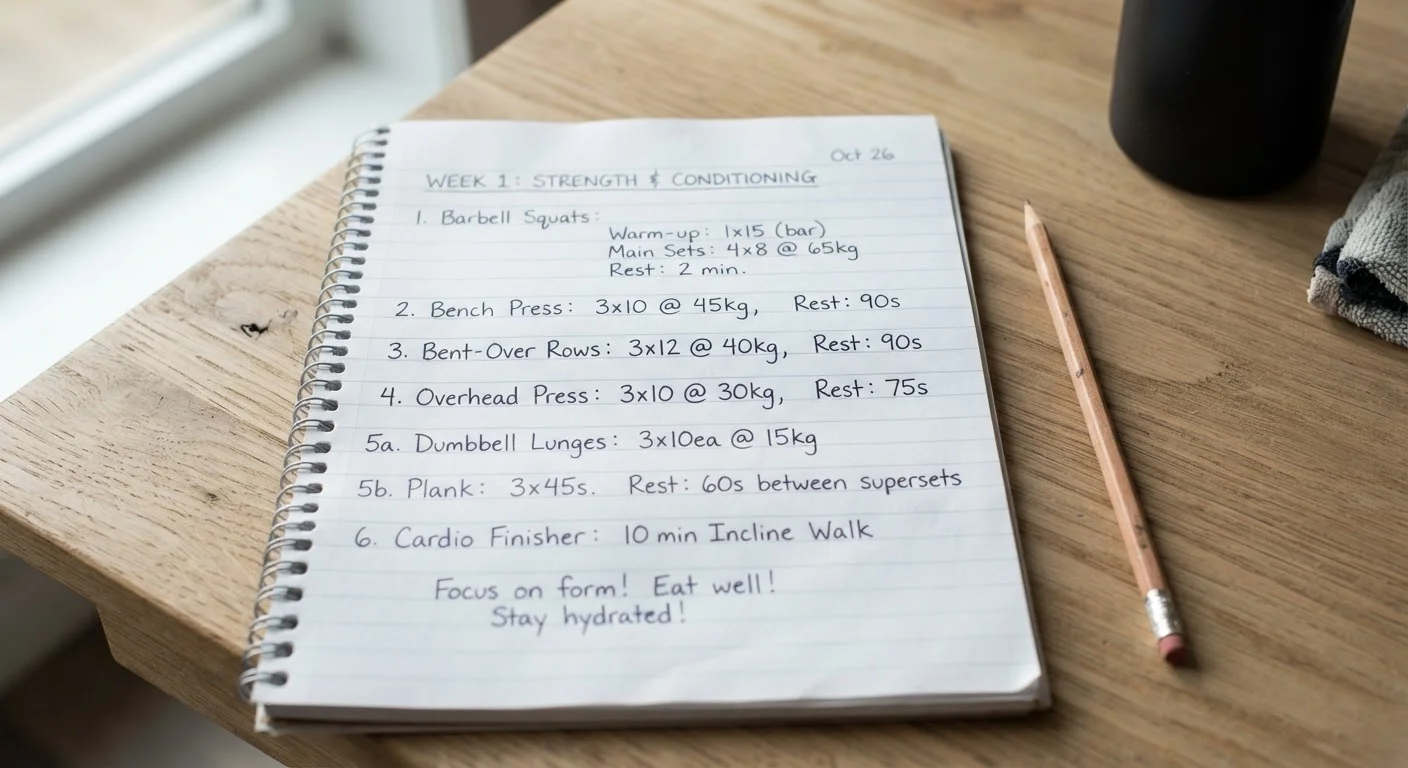
Photo: YetaWellness.com | Explore Trending Blogs editorial
Decoding Workout Shorthand
You've found a workout plan online, and it says something like 3×10 @ 60s rest. If that looks more like a math problem than a fitness instruction, you're not alone. These compact notations are the language of exercise programming — and once you understand them, any plan becomes far easier to follow.
Rep (Repetition)
One complete execution of an exercise movement from start to finish. For example, one full squat — lowering and standing back up — counts as one rep.
Set
A group of consecutive reps performed without stopping to rest. A plan calling for 3 sets means you repeat the prescribed reps three separate times.
Rest Period
The deliberate recovery time taken between sets. Rest duration is a programmable variable that affects muscle fatigue, heart rate, and training outcomes.
Tempo
The speed at which each phase of a movement is performed, often written as a series of numbers (e.g., 3-1-2). Controlling tempo can increase the challenge of an exercise without adding weight.
RPE (Rate of Perceived Exertion)
A subjective 1–10 scale used to gauge exercise intensity based on how hard the effort feels. It helps exercisers self-regulate effort regardless of equipment or setting.
1RM (One-Rep Max)
The maximum amount of weight a person can lift for a single rep of a given exercise with proper form. It is often used as a reference point to prescribe training loads.
The good news: there are really only a handful of terms you need to know. This reference guide breaks each one down in plain language so you can step into any workout with clarity and confidence.
Reps, Sets, and Rest: The Core Three
Reps (repetitions) are the most basic unit. One rep is one complete movement — one squat, one push-up, one bicep curl all the way up and all the way down. The number of reps you perform tells you how many times you do that movement in a row before stopping.
Sets are groups of reps. If your plan calls for 3 sets of 10 reps — written as 3×10 — you perform 10 consecutive reps, rest, then repeat that cycle two more times for three total rounds.
Rest is the recovery interval between sets. It is not optional filler — it is a deliberate variable. Shorter rest periods (30–60 seconds) keep your heart rate elevated and challenge muscular endurance. Longer rest periods (2–3 minutes) allow your muscles to recover more fully, which supports heavier lifting and maximal strength efforts. Exercise science consistently shows that rest duration meaningfully affects both performance and adaptation, so follow the rest guidance in your plan rather than skipping it.
| Common Notation Format | Sets × Reps (e.g., 3×10) |
| Endurance-Focused Rest | 30–60 seconds between sets (General exercise science guidance) |
| Hypertrophy-Focused Rest | 60–90 seconds between sets (General exercise science guidance) |
| Strength-Focused Rest | 2–3 minutes between sets (General exercise science guidance) |
| RPE Scale Range | 1 (very easy) to 10 (maximal effort) |
| AMRAP Meaning | As Many Reps As Possible |
Other Numbers You May See
Beyond the basic trio, workout plans often include a few additional notations worth knowing:
- Tempo (e.g., 3-1-2): Describes the speed of each phase of a movement — typically lowering, pausing, and lifting. A tempo of 3-1-2 means three seconds to lower, one second to pause, two seconds to lift. Controlled tempo increases time under tension, which can enhance muscle development.
- RPE (Rate of Perceived Exertion): A 1–10 scale indicating how hard an effort should feel. An RPE of 7 means the effort feels fairly hard but sustainable. This helps you self-regulate intensity without requiring specific equipment.
- AMRAP (As Many Reps As Possible): You perform as many reps as you can with good form in a set time or until you cannot continue safely.
- 1RM (One-Rep Max): The maximum weight you can lift for exactly one rep of a given exercise. Percentages of your 1RM (e.g., "work at 70% 1RM") are commonly used to prescribe load in strength programs.
Understanding how these numbers interact helps you train more intentionally. For context on how similar numerical literacy applies to nutrition, see how macronutrient numbers work on food labels.
Why These Variables Matter for Your Goals
The combination of reps, sets, and rest isn't arbitrary — it's engineered to produce specific physiological outcomes. Exercise scientists generally describe a spectrum from muscular endurance on one end to maximal strength on the other, with hypertrophy (muscle size) in the middle.
- Higher reps, shorter rest (e.g., 3×15–20, 30–45s rest): Tends to target muscular endurance and cardiovascular demand.
- Moderate reps, moderate rest (e.g., 3–4×8–12, 60–90s rest): A common range associated with building muscle size.
- Lower reps, longer rest (e.g., 4–5×3–6, 2–3 min rest): Associated with developing maximal strength.
These are general patterns supported by exercise science, not rigid rules. Individual response varies, and a qualified fitness professional can help tailor these variables to your specific situation — especially if you have any existing health conditions or are new to resistance training.
Rest also matters beyond the gym. Broader forms of rest — including sleep and mental recovery — play an important role in how well your body adapts to training over time. And understanding your overall body composition can provide useful context for tracking progress; see what body composition numbers really tell you for more.
This article is for general informational and educational purposes only and does not constitute medical or professional fitness advice. Consult a qualified healthcare provider or certified fitness professional before beginning any new exercise program, particularly if you have an existing health condition or injury.
The content on this site is for informational purposes only and is not a substitute for professional advice. Always consult a qualified professional for guidance specific to your situation.