
Working Out at Home vs. Going to a Gym

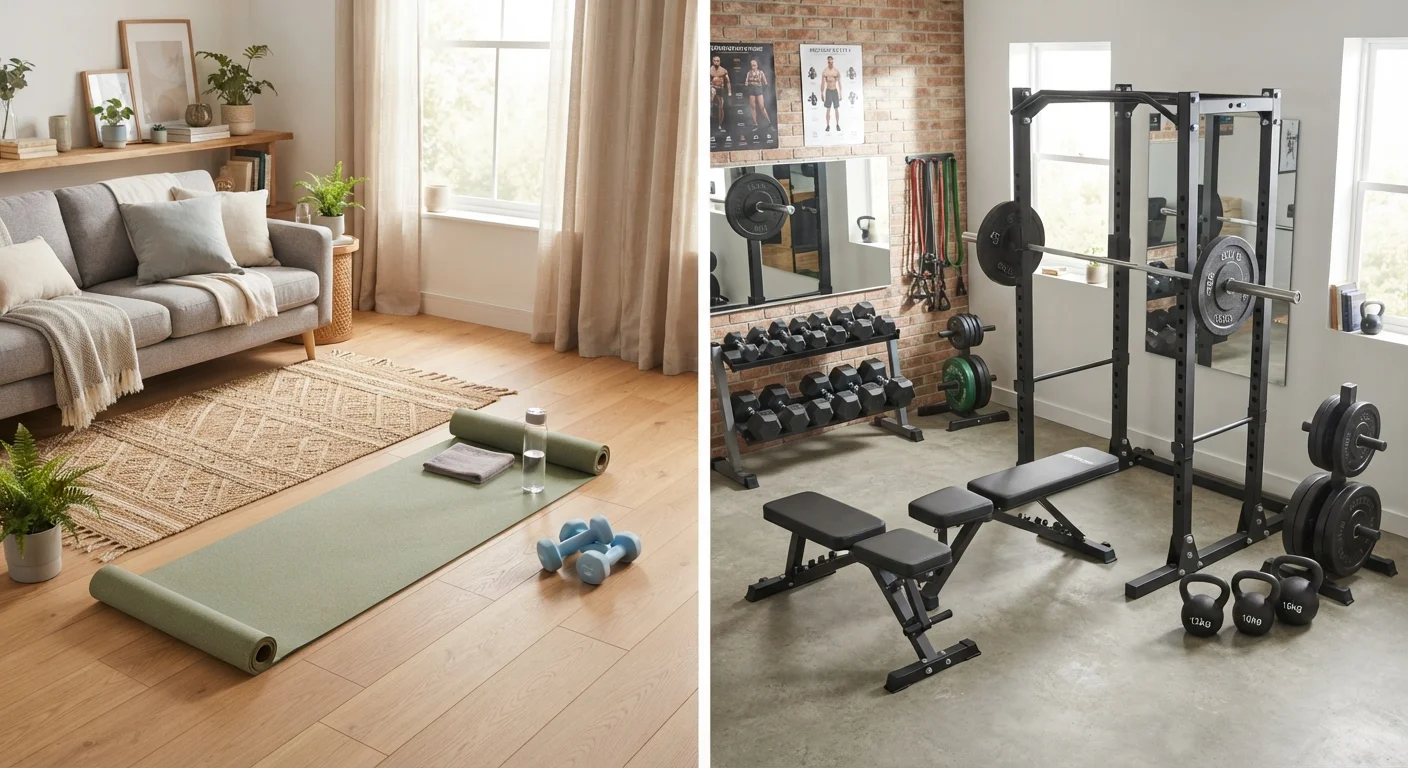
Photo: YetaWellness.com | Explore Trending Blogs editorial
Key Takeaways
- Home workouts offer convenience and cost savings but may lack equipment variety and social motivation.
- Gyms provide access to specialized equipment and structured environments that can accelerate certain training goals.
- Neither setting is universally superior — consistency matters more than location.
- A hybrid approach, training at home some days and at a gym others, works well for many people.
- Your schedule, budget, goals, and personality should drive the decision, not trends.
No commute — train whenever it fits your schedule
Removing travel time reduces a major barrier to consistency. Even a 15-minute session at home is more accessible than a session requiring a round-trip commute.
Lower ongoing cost after initial setup
A modest set of resistance bands, a mat, or adjustable dumbbells often pays for itself within a few months compared to recurring gym membership fees.
Privacy and comfort on your own terms
Training at home removes self-consciousness about form, appearance, or pace — a real benefit for beginners or those returning to exercise after a break.
Flexible scheduling around life demands
Home training fits more easily around childcare, irregular work hours, or other responsibilities that make fixed gym hours impractical.
Equipment limitations cap certain training goals
Progressive overload for strength training requires increasing resistance over time. Without a range of weights or machines, home setups can plateau for more advanced lifters.
Distractions and lack of dedicated space
Household chores, family members, notifications, and the general comfort of home can interrupt focus and reduce session quality compared to a purpose-built environment.
Membership fees add a recurring financial commitment
Monthly gym costs vary widely, but even a modest membership represents a budget line that not everyone can sustain long-term, especially if attendance drops.
Social pressure can feel intimidating for beginners
Crowded weight rooms or unfamiliar equipment can feel unwelcoming, particularly for those new to structured fitness routines.
Why the Setting Matters — But Not as Much as You Think
The debate between working out at home and going to a gym is a practical one, not a philosophical contest. Research on exercise adherence consistently points to one overriding factor: the people who stick with exercise long-term are those who build it into routines they can actually sustain. Location is a supporting variable in that equation.
That said, the two settings offer genuinely different experiences, resources, and psychological cues. Understanding those differences helps you make a choice grounded in your real life — not in what looks appealing on a fitness app. Whether you're building a daily movement habit from scratch or reconsidering an existing routine, the tradeoffs below are worth examining honestly.
The Case for Working Out at Home
Home training has expanded dramatically beyond floor exercises and resistance bands. Bodyweight programs, adjustable dumbbells, pull-up bars, and streaming workout platforms have made it possible to train effectively in a small space without a membership fee.
No commute — train whenever it fits your schedule
Removing travel time reduces a major barrier to consistency. Even a 15-minute session at home is more accessible than a session requiring a round-trip commute.
Lower ongoing cost after initial setup
A modest set of resistance bands, a mat, or adjustable dumbbells often pays for itself within a few months compared to recurring gym membership fees.
Privacy and comfort on your own terms
Training at home removes self-consciousness about form, appearance, or pace — a real benefit for beginners or those returning to exercise after a break.
Flexible scheduling around life demands
Home training fits more easily around childcare, irregular work hours, or other responsibilities that make fixed gym hours impractical.
For people with unpredictable schedules, caregiving responsibilities, or limited transportation, eliminating the commute to a gym can be the difference between exercising and not exercising. A workout completed at 6 a.m. in your living room counts exactly as much as one done at a commercial facility. If gym-free movement aligns with your lifestyle, evidence-informed approaches to staying active without a membership can help you build a sustainable structure.
The Case for Going to a Gym
A gym provides infrastructure that is genuinely difficult to replicate at home — particularly for strength training at heavier loads, sport-specific conditioning, or access to supervised group classes.
Equipment limitations cap certain training goals
Progressive overload for strength training requires increasing resistance over time. Without a range of weights or machines, home setups can plateau for more advanced lifters.
Distractions and lack of dedicated space
Household chores, family members, notifications, and the general comfort of home can interrupt focus and reduce session quality compared to a purpose-built environment.
Membership fees add a recurring financial commitment
Monthly gym costs vary widely, but even a modest membership represents a budget line that not everyone can sustain long-term, especially if attendance drops.
Social pressure can feel intimidating for beginners
Crowded weight rooms or unfamiliar equipment can feel unwelcoming, particularly for those new to structured fitness routines.
The social dimension of a gym is also underappreciated. Exercising alongside others, even strangers, can increase motivation and effort through a well-documented phenomenon called social facilitation. Many people find that leaving the home environment and entering a dedicated fitness space helps them mentally transition into a training mindset. For workouts that combine aerobic and strength components — see how aerobic and anaerobic exercise differ — a gym's range of equipment makes programming more flexible.
Special Populations: Check With a Professional First
Making the Choice That Sticks
Rather than treating this as a permanent, either/or commitment, consider what barriers most often derail your consistency. If getting to a gym takes 30 minutes each way, that's roughly 60 minutes of non-exercise time every session — a real cost worth factoring in. If working out at home means constantly getting interrupted or losing focus, a gym's dedicated environment may be worth the membership fee.
A hybrid approach works for many people: foundational or cardio-focused sessions at home, heavier strength work or classes at a gym. You might also explore what outdoor movement offers that indoor settings don't as a third option worth layering in. The goal is a routine that remains realistic across your busiest weeks, not just your ideal ones.
~23%
U.S. adults meeting aerobic and strength guidelines
According to the CDC, fewer than one in four American adults meets both the aerobic and muscle-strengthening components of federal physical activity guidelines — regardless of where they work out.
150 min
Weekly moderate-intensity activity recommended
The U.S. Department of Health and Human Services Physical Activity Guidelines recommend at least 150 minutes of moderate-intensity aerobic activity per week for most adults — achievable in either setting.
This article is for general informational purposes only and is not a substitute for professional medical or fitness advice. Consult a qualified healthcare provider before beginning a new exercise program, especially if you have existing health conditions.
The content on this site is for informational purposes only and is not a substitute for professional advice. Always consult a qualified professional for guidance specific to your situation.