
Skin in Your 40s vs. Your 60s: Understanding the Structural Differences

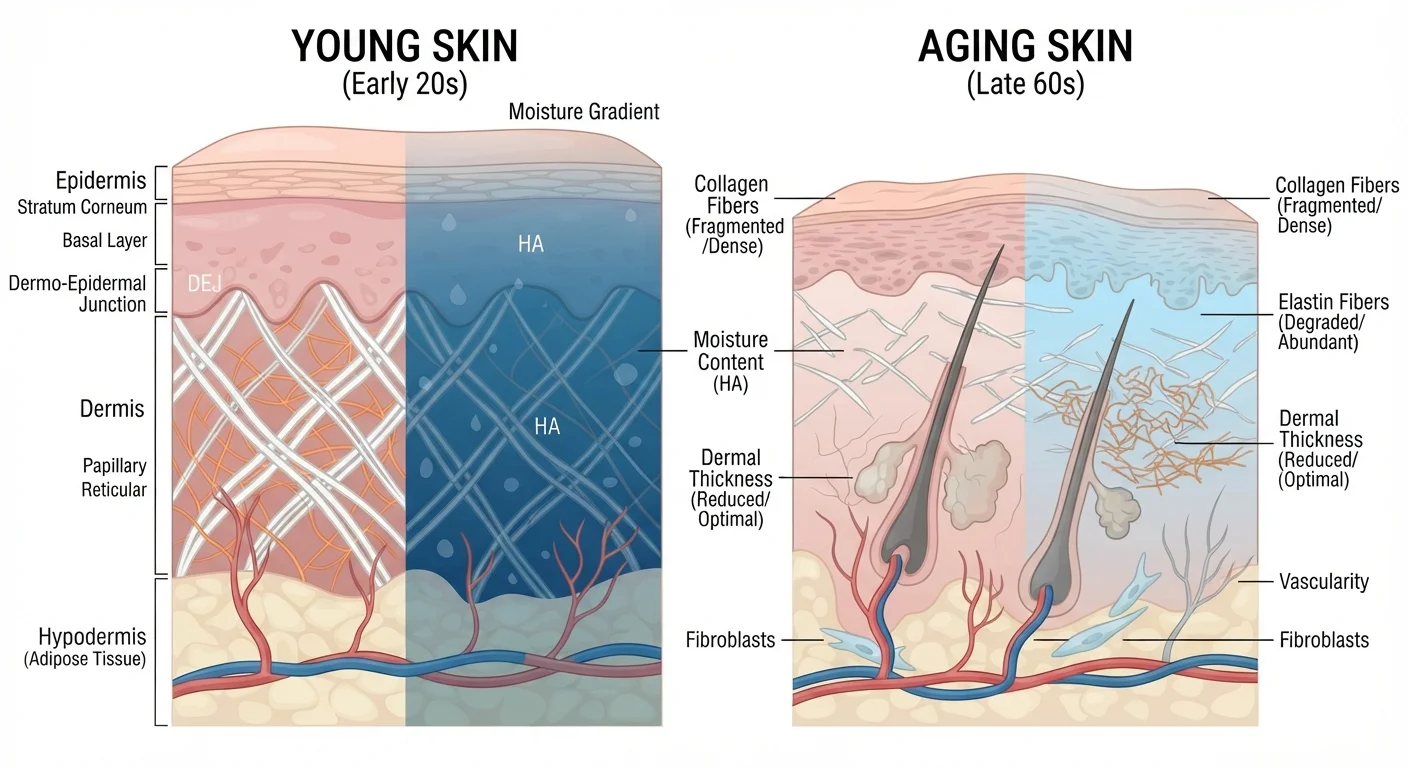
Photo: YetaWellness.com | Explore Trending Blogs editorial
Key Takeaways
- Collagen production begins declining noticeably in the 40s and accelerates significantly in the 60s, especially after menopause.
- Elastin fibers become fewer and less functional with age, reducing the skin's ability to snap back after stretching.
- Moisture retention decreases across both decades due to declining natural moisturizing factors and a thinner skin barrier.
- Sun exposure and smoking compound intrinsic aging, making cumulative UV damage more visible by the 60s.
- Skin thickness drops measurably between the 40s and 60s, increasing vulnerability to bruising and slower wound healing.
- Lifestyle habits — including sun protection, hydration, and nutrition — continue to influence skin structure at every decade.
The Structural Biology of Aging Skin
Skin aging is not a single event but a continuous biological process shaped by two overlapping forces: intrinsic aging (driven by genetics and time) and extrinsic aging (driven by environment, particularly UV radiation). Both forces act on the same structural proteins — primarily collagen and elastin — but the pace and severity of change differ considerably between your 40s and your 60s.
Collagen, the scaffolding protein that gives skin its firmness, begins declining at roughly 1% per year after early adulthood. By the 40s, this slow loss becomes functionally noticeable. Elastin — the protein responsible for skin's recoil — also degrades progressively, though its fibers are not regenerated as efficiently with age. These changes don't happen in isolation; the dermis (the skin's middle layer) also thins, and the boundary between the dermis and epidermis flattens, reducing nutrient and oxygen exchange. This broader structural context helps explain why changes in your 60s feel qualitatively different, not just more of the same. See our decade-by-decade reference on physical aging milestones for a broader view of how these timelines intersect.
Side-by-Side: How Skin Differs Across the Two Decades
The table below summarizes the key structural differences that research in dermatology and gerontology has documented between these two life stages. Individual variation is significant — genetics, lifetime sun exposure, smoking history, and hormonal factors all influence where any given person falls within these ranges.
| Criterion | Skin in Your 40s | Skin in Your 60s |
|---|---|---|
| Collagen density | Gradual decline underway; firmness subtly reduced | Significant loss; skin visibly thinner and less firm |
| Elastin function | Mild reduction; slower recoil begins | Marked degradation; skin snaps back more slowly |
| Skin thickness | Modest thinning of dermis | Measurable reduction; increased bruising risk |
| Moisture retention | Slight decrease; dryness in some conditions | Greater transepidermal water loss; dryness more chronic |
| Hormonal influence | Perimenopause may begin; early estrogen shifts | Post-menopausal; estrogen-driven collagen loss accelerated |
| Wound healing | Mildly slower than younger decades | Noticeably slower; reduced cell turnover |
| Pigmentation changes | Early age spots may appear on sun-exposed areas | Solar lentigines more prevalent and pronounced |
| Sebaceous (oil) gland activity | Begins to decrease; some dryness | Further reduced; less natural lubrication |
One particularly important inflection point is menopause. Estrogen plays a substantial role in collagen synthesis and skin hydration. Research published in dermatology literature indicates that skin may lose as much as 30% of its collagen in the first five years following menopause — a period that often falls within or just before the 60s for many women. This hormonal shift accelerates what would otherwise be a more gradual decline.
Moisture Retention and Barrier Function
The skin's ability to retain moisture depends on a network of lipids (fats), proteins like filaggrin, and molecules called natural moisturizing factors (NMFs) — compounds including amino acids and urea that bind water within the outer skin layer (stratum corneum). Both the quantity of NMFs and the quality of the lipid barrier decline with age.
In the 40s, many people begin noticing increased dryness or sensitivity — particularly in low-humidity environments or after prolonged sun exposure. By the 60s, the barrier is measurably thinner and less effective, contributing to greater transepidermal water loss (TEWL) — the rate at which moisture evaporates through the skin. This isn't simply cosmetic: a compromised barrier is more reactive to irritants, more vulnerable to infection, and slower to recover from minor injury.
Adequate hydration, gentle cleansing that preserves natural oils, and moisturizers containing humectants (like glycerin or hyaluronic acid) and occlusives (like petrolatum) are well-supported strategies for supporting barrier function, though individual skin needs vary. Consulting a board-certified dermatologist is advisable for persistent dryness or irritation, especially in later decades.
Cumulative Damage and Visible Aging
By the 60s, the skin bears decades of accumulated extrinsic stressors. Ultraviolet radiation is the most significant of these, responsible for a phenomenon dermatologists call photoaging — a distinct pattern of deep wrinkling, pigmentation irregularities, and loss of skin tone that differs from chronological aging alone. Photoaging compounds the intrinsic collagen loss already underway, accelerating both texture changes and the appearance of age spots (solar lentigines).
Cumulative exposure to cigarette smoke, air pollution, and repeated mechanical stress also leaves a detectable mark by this decade. These aren't irreversible in all respects — sun protection at any age continues to reduce further damage — but the visible legacy of prior exposure is generally more apparent in the 60s than in the 40s. This parallels patterns seen in other connective tissues; our article on joint health across decades explores how cartilage and synovial fluid undergo similarly cumulative changes over time.
This article is for informational purposes only and does not constitute medical advice. For personalized guidance on skin health, consult a qualified healthcare provider or board-certified dermatologist.
The content on this site is for informational purposes only and is not a substitute for professional advice. Always consult a qualified professional for guidance specific to your situation.