
A Glossary of Emotional Health Terms Worth Knowing

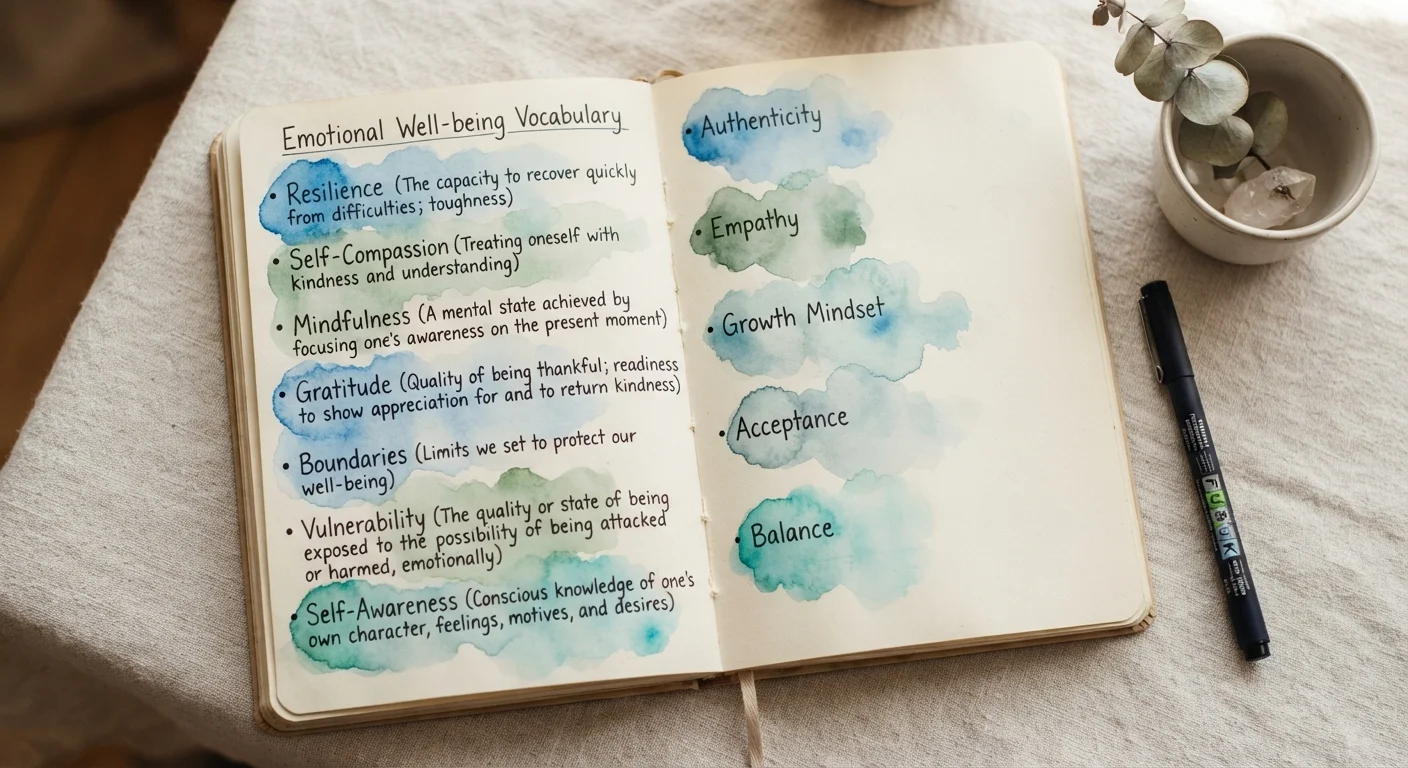
Photo: YetaWellness.com | Explore Trending Blogs editorial
Why Emotional Health Vocabulary Matters
You've probably encountered terms like emotional regulation or psychological safety in a wellness article, a therapy session, or even a workplace training — but without a clear definition, these phrases can feel more like buzzwords than useful tools. Building a working vocabulary around emotional health isn't about becoming a clinician; it's about gaining precision.
Research suggests that being able to name feelings specifically — a skill called emotion granularity — is linked to better emotional regulation and lower reactivity. When you can label what you're experiencing with accuracy, you're better equipped to respond rather than react. See our guide to naming feelings more precisely for a deeper look at why this skill matters.
This reference covers the terms most commonly encountered in therapy discussions, wellness content, and psychological research — explained in plain, accessible language. It is general educational information, not medical advice. If you're navigating significant emotional difficulties, please consult a qualified mental health professional.
Affect
A broad term referring to the experience of feeling or emotion, encompassing both mood and discrete emotional states. In clinical settings, clinicians may assess a person's affect — such as whether it appears flat, labile, or congruent with speech — as part of a mental status evaluation.
Emotional Regulation
The ability to manage and modulate emotional responses in a way that is flexible and appropriate to the situation. It includes strategies like reappraisal, mindful awareness, and behavioral coping — and is considered a core component of psychological well-being.
Emotional Granularity
The capacity to distinguish between subtle differences in emotional states — for example, recognizing the distinction between feeling 'anxious' and 'dread,' or 'sad' and 'bereft.' Higher granularity is associated with more adaptive emotional responses.
Window of Tolerance
A concept from trauma-informed care describing the zone of emotional arousal in which a person can function effectively. Within this window, a person can process experiences without becoming overwhelmed (hyperaroused) or shutting down (hypoaroused).
Dysregulation
A state in which emotional responses feel uncontrollable, disproportionate, or difficult to return to baseline. Dysregulation is not a diagnosis; it describes a temporary or ongoing difficulty with managing the intensity of emotions.
Rumination
The repetitive, passive focus on distressing thoughts or feelings without moving toward problem-solving. Research links chronic rumination to increased risk of depression and anxiety — distinguishing it from healthy reflection or processing.
Psychological Safety
A condition in which a person feels safe to express thoughts, feelings, and vulnerabilities without fear of punishment, judgment, or ridicule. Originally studied in workplace contexts, it is equally relevant to therapeutic and relational settings.
Somatic Awareness
The practice of noticing bodily sensations — such as tightness in the chest, a racing heart, or shallow breath — as signals of emotional states. Many therapeutic approaches, including somatic therapy and mindfulness-based practices, use this awareness as an entry point for emotional processing.
Attunement
The capacity to perceive and respond sensitively to another person's emotional state. Originally used to describe the parent-child relationship, attunement is now discussed broadly in the context of empathy, therapeutic relationships, and close partnerships.
Resilience
The ability to adapt and recover from adversity, stress, or significant challenges. Resilience is not a fixed trait — research indicates it can be cultivated through social connection, self-regulation skills, and supportive environments.
Alexithymia
A subclinical trait characterized by difficulty identifying and describing one's own feelings, as well as limited imaginative thinking about emotions. People with high alexithymia may recognize physical symptoms of emotion before — or instead of — the feeling itself.
Containment
A therapeutic concept referring to the ability to hold difficult emotions without being overwhelmed by them or acting on them impulsively. It can also describe the role a therapist or trusted person plays in providing a safe space for someone to express intense feelings.
How to Use This Reference
The terms below are grouped by how they tend to appear in practice — from foundational emotional concepts to therapy-adjacent language you may encounter in self-help or clinical contexts. Each definition is intentionally brief; for broader context on how emotions and moods interact, see the complete overview of mood, emotions, and mental health.
| Terms in this glossary | 12 core emotional health concepts |
| Common context for these terms | Therapy, wellness content, and psychological research |
| Emotion granularity benefit | Linked to better emotional regulation (Barrett et al., psychological research literature) |
| Resilience classification | A learnable skill, not a fixed personality trait (American Psychological Association) |
| Window of tolerance origin | Developed within trauma-informed clinical frameworks (Dan Siegel, interpersonal neurobiology) |
If you're specifically researching stress-related language such as cortisol, hyperarousal, or vagal tone, the reference guide to common stress and anxiety terms covers that territory in detail. For the distinction between a mood and an emotion — two terms often used interchangeably but with important differences — visit our article on mood vs. emotion.
If you want to put these concepts into active practice, journaling for emotional clarity offers evidence-informed approaches for processing what you're feeling in writing.
This article is for informational and educational purposes only and does not constitute medical or psychological advice. Please consult a licensed mental health professional for guidance specific to your situation.
The content on this site is for informational purposes only and is not a substitute for professional advice. Always consult a qualified professional for guidance specific to your situation.