
REM Sleep vs. Deep Sleep: Two Stages, Very Different Jobs

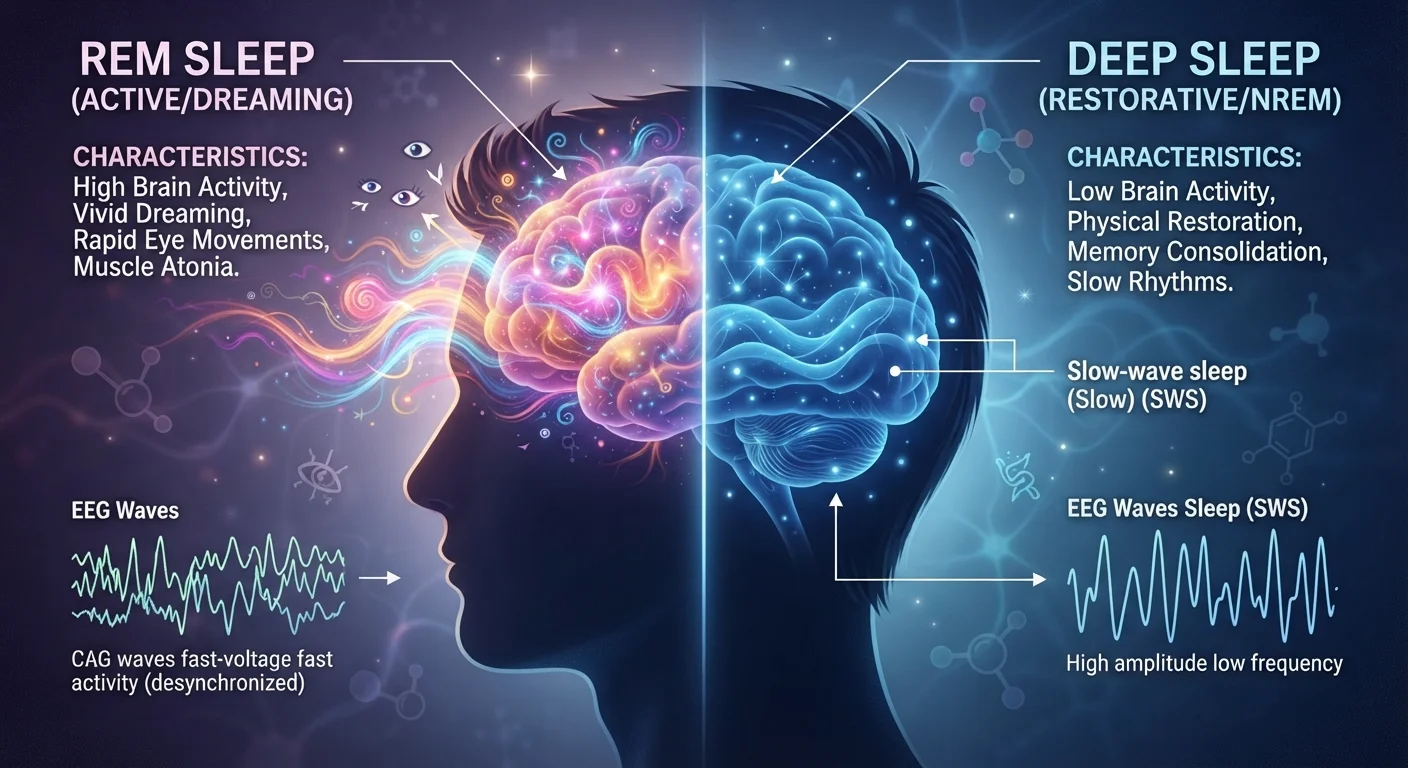
Photo: YetaWellness.com | Explore Trending Blogs editorial
Key Takeaways
- REM sleep drives memory consolidation and emotional regulation; deep sleep handles physical repair.
- Deep sleep dominates early in the night; REM periods grow longer toward morning.
- Both stages are essential — shortchanging either one carries measurable cognitive and physical costs.
- Alcohol, inconsistent sleep timing, and sleep disorders can selectively suppress one stage over the other.
- You cannot consciously choose which stage to prioritize; the brain regulates the balance automatically.
Where Each Stage Fits in the Sleep Cycle
Sleep is not a uniform, passive state. Throughout the night, the brain cycles through distinct stages roughly every 90 minutes, and two of those stages — REM (Rapid Eye Movement) sleep and deep sleep, formally called slow-wave sleep or N3 — are the most biologically active. Understanding where they fall in the night helps explain why cutting sleep short hits both stages differently.
Deep sleep appears predominantly in the first two sleep cycles, meaning the first three to four hours of a full night. REM sleep, by contrast, becomes progressively longer in each subsequent cycle, with the most substantial REM periods occurring in the final hours before waking. This distribution is not random — it reflects the brain's prioritization of physical repair early and cognitive processing later.
For a fuller picture of how the brain moves through all sleep stages, see The Architecture of a Night's Sleep.
| Criterion | REM Sleep | Deep Sleep (Slow-Wave Sleep) |
|---|---|---|
| Brain activity | Near-waking levels of activity | Slow, synchronized delta waves |
| When it peaks | Final hours of the night | First third of the night |
| Primary role | Memory consolidation, emotional processing | Physical repair, cellular restoration |
| Dreaming | Vivid dreaming common | Dreaming rare or minimal |
| Muscle tone | Temporary paralysis (atonia) | Deeply relaxed but not paralyzed |
| Hormone activity | Cortisol and acetylcholine active | Growth hormone peaks |
| Disrupted by | Alcohol, some antidepressants | Age, sleep deprivation, fragmentation |
| Recovery priority | Recovered in later cycles after deprivation | Recovered first after sleep deprivation |
What Deep Sleep Actually Does
During deep sleep, brain activity slows into large, synchronized waves — the "slow waves" that give this stage its scientific name. The brain becomes highly resistant to waking, and the body enters its most pronounced state of physical restoration.
Key processes driven by deep sleep include:
- Growth hormone secretion: The pituitary gland releases the majority of its nightly growth hormone during slow-wave sleep, supporting muscle repair and cellular regeneration.
- Glymphatic clearance: Research published in Science (Xie et al., 2013) demonstrated that the brain's glymphatic system — a waste-clearance network — becomes significantly more active during slow-wave sleep, flushing metabolic byproducts including amyloid-beta proteins linked to Alzheimer's disease.
- Immune system support: Deep sleep is associated with the release of cytokines, signaling proteins that support immune function and inflammatory response.
- Memory consolidation (declarative): While REM sleep handles much of memory processing, deep sleep plays a specific role in stabilizing factual and event-based memories.
Deep sleep decreases naturally with age, which is one reason older adults often report feeling less physically restored even after a full night in bed.
13–23%
Typical proportion of night spent in deep sleep
According to the American Sleep Association, healthy adults spend roughly 13–23% of total sleep time in slow-wave (deep) sleep, declining with age.
20–25%
Typical proportion of night spent in REM sleep
The National Sleep Foundation estimates that healthy adults spend approximately 20–25% of total sleep time in REM, with the longest REM periods occurring in the final sleep cycles.
4–6
Sleep cycles completed in a full night
A full night of sleep typically involves four to six 90-minute cycles, each containing both NREM and REM stages in shifting proportions.
What REM Sleep Actually Does
REM sleep looks strikingly different from every other stage. The brain becomes nearly as active as it is during wakefulness, the eyes move rapidly beneath closed lids, and the body's major muscle groups are temporarily paralyzed — a mechanism that prevents acting out vivid dreams. Most dreaming occurs during REM.
The functions of REM sleep are concentrated in the cognitive and emotional domains:
- Emotional memory processing: REM sleep appears to help the brain reprocess emotionally charged experiences, reducing their affective intensity over time. Researchers including Matthew Walker at UC Berkeley have described this as "overnight therapy."
- Procedural and associative memory: Skills learned during waking — from playing an instrument to navigating a new route — are consolidated during REM sleep. Studies show that subjects tested after REM-rich sleep outperform those whose REM was interrupted.
- Creative problem-solving: The associative, loosely connected nature of REM brain activity may underlie insight and novel pattern recognition, a hypothesis supported by multiple experimental studies.
REM disruption has measurable consequences for mood and mental health. For more on the connection between restorative sleep and emotional wellbeing, see Restorative Sleep and Mental Health.
What Disrupts Each Stage — and How to Protect Both
Different factors selectively suppress each stage, which is why knowing the distinction matters practically:
- Alcohol is one of the most potent suppressors of REM sleep. Even moderate evening consumption fragments REM architecture in the latter half of the night, when REM periods are longest.
- Sleep deprivation triggers a rebound effect in both stages — but deep sleep is typically recovered first, suggesting the brain ranks it as the higher biological priority.
- Stimulants and certain medications (including some antidepressants) are known to suppress REM sleep; this should always be discussed with a prescribing clinician rather than managed independently.
- Inconsistent sleep timing disrupts circadian rhythms in ways that compress both deep sleep and REM, since each is tightly linked to time-of-night position rather than just total hours.
The single most evidence-backed strategy for protecting both stages is straightforward: obtain sufficient total sleep at consistent times. The brain's internal scheduling handles the rest. Attempting to "target" a specific stage through lifestyle choices has limited scientific support; the architecture regulates itself when given adequate time and regularity.
If you suspect you're consistently missing restorative sleep despite sufficient hours in bed, that pattern is worth discussing with a healthcare provider — it may reflect an underlying sleep disorder. Understanding the difference between short sleep and insomnia can help clarify what warrants clinical attention.
This article is for general informational and educational purposes only and does not constitute medical advice. Consult a qualified healthcare professional for any concerns about your sleep health or before making changes to your care.
The content on this site is for informational purposes only and is not a substitute for professional advice. Always consult a qualified professional for guidance specific to your situation.