
Sleep Across the Lifespan: How Biology Changes From Infancy to Old Age

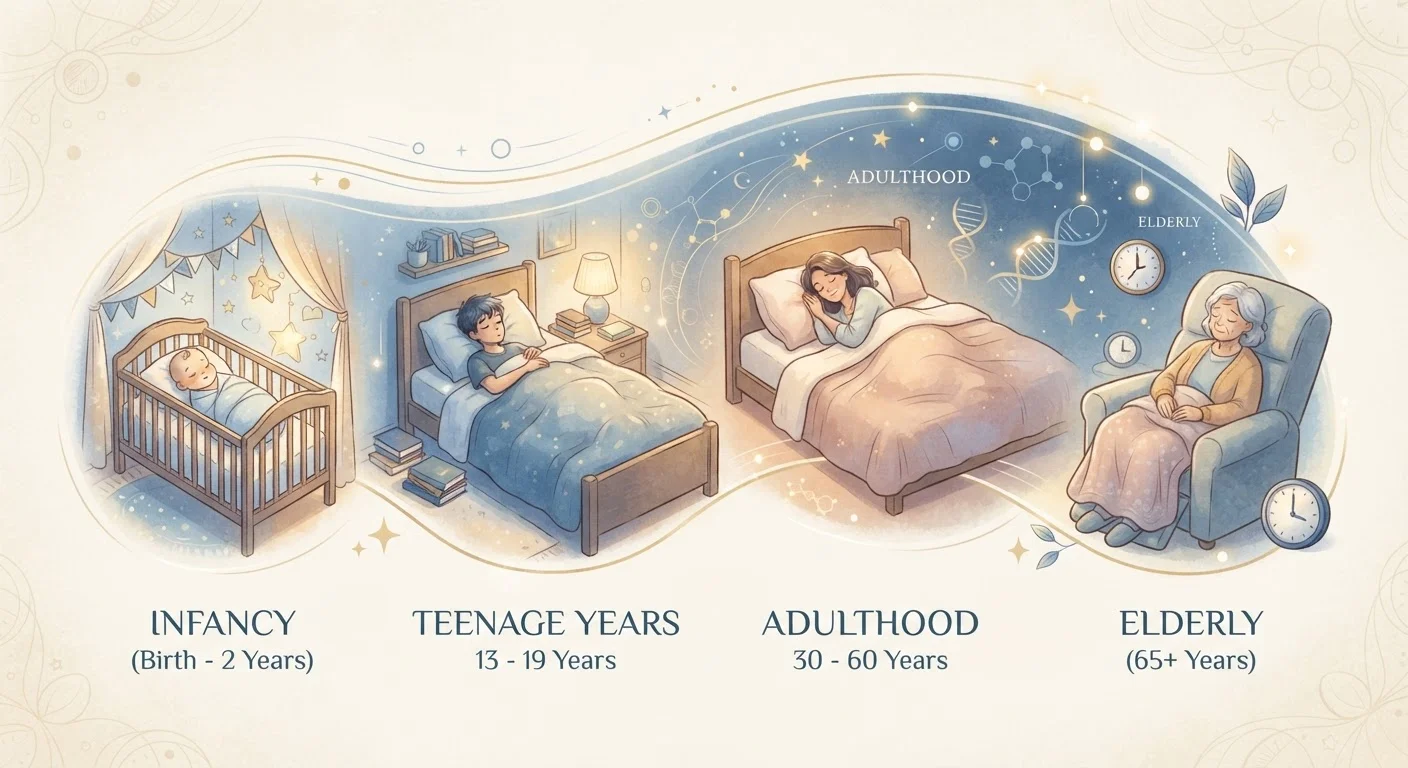
Photo: YetaWellness.com | Explore Trending Blogs editorial
Why Sleep Looks So Different at Every Age
Sleep is not one fixed biological state — it is a moving target shaped by development, hormones, and the brain's changing architecture. A newborn and a 70-year-old live in fundamentally different sleep worlds, yet both are operating exactly as biology intends for their stage of life. Understanding these differences helps caregivers set realistic expectations, helps adults recognize when something has genuinely changed, and helps everyone distinguish normal aging from a disorder worth evaluating.
To follow the changes described below, it helps to understand the basics of sleep stages. Sleep cycles and their stages — including light NREM, deep slow-wave sleep, and REM — are the foundation on which every age-related shift is built.
| Newborn sleep need (0–3 months) | 14–17 hours per day (American Academy of Sleep Medicine) |
| REM proportion in newborns | ~50% of total sleep (Compared to ~20–25% in healthy adults) |
| Teen sleep need (14–17 years) | 8–10 hours per night (American Academy of Sleep Medicine) |
| Adolescent circadian delay | ~2 hours later than childhood (Driven by pubertal hormonal changes) |
| Adult sleep need (18–64 years) | 7–9 hours per night (American Academy of Sleep Medicine) |
| Older adult sleep need (65+) | 7–8 hours per night (American Academy of Sleep Medicine) |
| NREM–REM cycle length | ~90 minutes in adults; ~50 minutes in newborns (Standard sleep architecture research) |
Infants and Toddlers: Building the Brain Through Sleep
Newborns sleep 14–17 hours per day, according to the American Academy of Sleep Medicine, yet their sleep architecture looks almost nothing like an adult's. They cycle between active sleep (equivalent to REM) and quiet sleep roughly every 50 minutes, compared to the approximately 90-minute cycle in adults. Active sleep dominates — occupying up to 50% of total sleep time — because it drives the intense synaptic development happening in a rapidly growing brain.
By around 3–6 months, circadian rhythm — the internal 24-hour clock — begins to consolidate, driven largely by the maturation of the suprachiasmatic nucleus and increasing melatonin secretion in response to darkness. This is why sustained nighttime sleep first becomes possible in early infancy, not from birth. Toddlers (ages 1–3) still need 11–14 hours, and daytime napping remains biologically appropriate through at least age 3 for most children.
Childhood Through Adolescence: The Great Phase Shift
School-age children (ages 6–12) typically need 9–12 hours and generally show strong, efficient slow-wave (deep) sleep — the restorative stage critical for memory consolidation, growth hormone release, and immune function. Deep sleep is proportionally greater in children than at any other life stage.
Adolescence introduces one of the most well-documented biological changes in sleep science: a delayed circadian phase. Research shows that pubertal development shifts the internal clock later, making teenagers genuinely unable to fall asleep early — not simply unwilling. Melatonin onset moves roughly 2 hours later compared to childhood. As a result, early school start times place a large portion of the teenage population in a state of chronic partial sleep deprivation, with documented consequences for cognition, mood, and metabolic health. Teens require 8–10 hours, but surveys consistently find most American adolescents fall well short of that target.
For a deeper look at how the sleeping brain changes stage by stage, see what researchers have documented about neural activity across each sleep stage.
Adulthood and Aging: Gradual Architecture Shifts
Adults ages 18–64 require 7–9 hours, and healthy adult sleep follows a relatively stable architecture: four to six 90-minute cycles per night alternating NREM and REM, with deep slow-wave sleep concentrated in the first half and REM lengthening toward morning. Genetic variation accounts for some individual differences in how much sleep a given person needs, though true short-sleepers are far rarer than self-reports suggest.
From middle age onward, measurable changes accumulate. Slow-wave sleep declines — sometimes dramatically — beginning in the 30s and 40s, even in otherwise healthy adults. Circadian timing shifts forward (advancing, rather than the delay seen in teenagers), causing earlier natural sleep and wake times. Sleep becomes more fragmented, with more brief arousals per night, and total sleep efficiency — the percentage of time in bed actually spent asleep — decreases. These shifts are covered in depth in our companion article on how sleep architecture changes with age.
Hormonal changes amplify these structural shifts. Growth hormone secretion, closely tied to slow-wave sleep, declines with age. Melatonin production also decreases, blunting the evening signal that promotes sleep onset. In women, menopause introduces additional disruption through hot flashes and shifting estrogen and progesterone levels — hormones with direct effects on sleep regulation. The broader picture of hormonal shifts across adulthood is relevant context here.
Older adults (65+) need 7–8 hours, though achieving that amount is often harder. Increased prevalence of pain, medication effects, and sleep disorders such as sleep apnea and restless legs syndrome contribute independently of normal aging. It is important to distinguish age-related changes from treatable conditions — fragmented sleep in an older adult is not simply inevitable, and evaluation by a healthcare provider is worthwhile when daytime function is affected.
This article is for informational purposes only and is not a substitute for professional medical advice. If you have concerns about your sleep or a family member's sleep at any life stage, consult a qualified healthcare provider.
The content on this site is for informational purposes only and is not a substitute for professional advice. Always consult a qualified professional for guidance specific to your situation.