
Body Composition Through the Lifespan: How Muscle and Fat Shift from Youth to Old Age

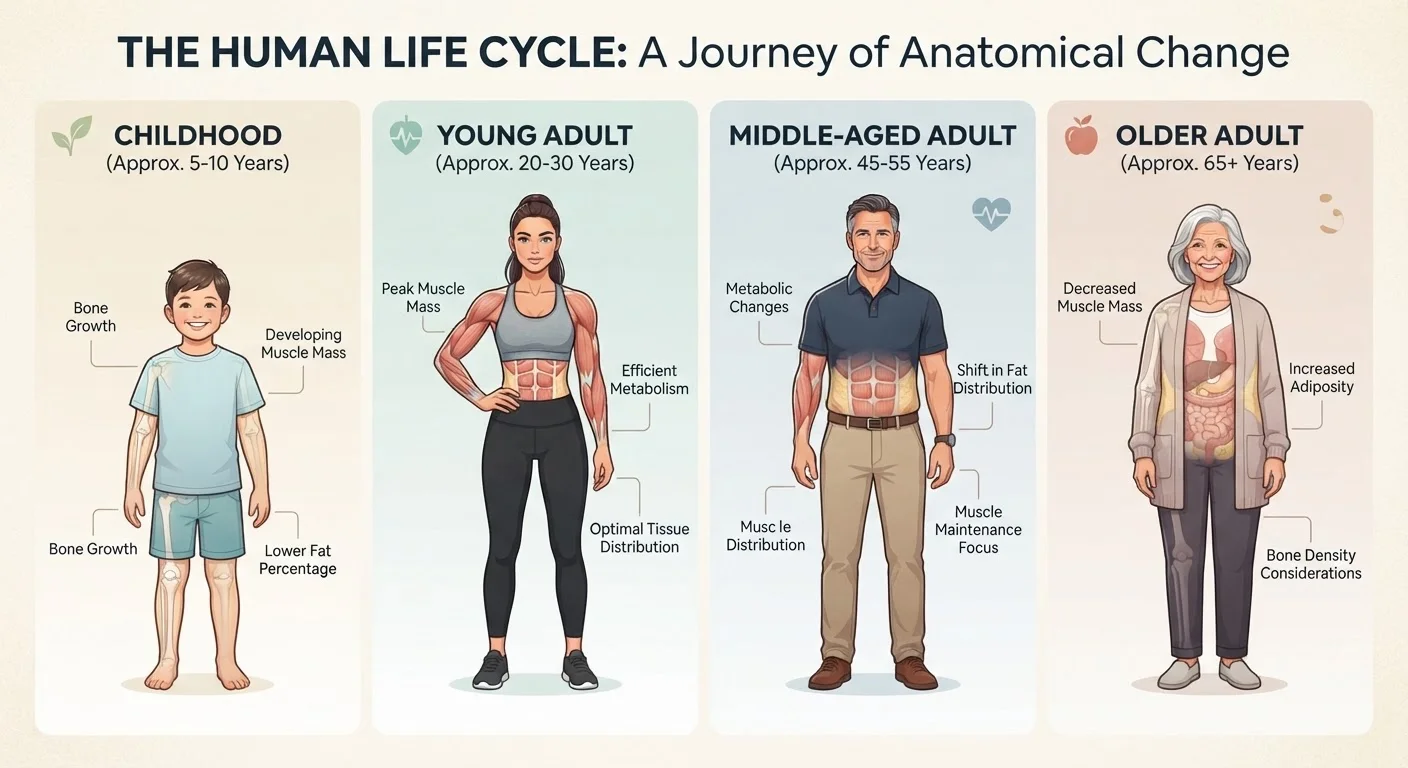
Photo: YetaWellness.com | Explore Trending Blogs editorial
Key Takeaways
- Muscle mass peaks in early adulthood and declines gradually from the 30s onward without active resistance training.
- Fat redistribution - not just total fat gain - is driven heavily by hormonal changes at each life stage.
- Sarcopenia, the age-related loss of muscle, accelerates after 60 and is associated with functional decline.
- Body composition differences between sexes are significant and clinically meaningful throughout life.
- Lifestyle factors like resistance exercise and adequate protein intake can modify - though not fully reverse - age-related shifts.
- Weight on a scale does not reflect changes in muscle-to-fat ratio; body composition metrics provide more useful context.
What Body Composition Actually Means
Body composition refers to the proportion and distribution of different tissue types in the body - primarily fat mass, lean muscle mass, bone, and water. Unlike body weight alone, composition reveals what the body is made of, not just how much it weighs. This distinction matters because, as explored in muscle vs. fat science, two people at identical weights can have dramatically different health profiles depending on their tissue makeup.
For those newer to these concepts, body composition basics provides a solid foundation. This guide builds on that foundation by tracing how composition shifts across a lifetime - a process that is largely predictable, biologically driven, and more nuanced than popular health narratives tend to acknowledge.
This article is for general health education and is not a substitute for personalized medical advice. Always consult a qualified healthcare provider for guidance specific to your circumstances.
Childhood and Adolescence: The Foundation Years
From birth through adolescence, the body undergoes its most dramatic compositional transformation. Infants carry a relatively high fat-to-lean ratio, which supports thermoregulation and brain development. As children grow, lean mass - bone and muscle - accumulates rapidly, while relative fat percentage typically decreases through middle childhood.
Puberty fundamentally reshapes composition along hormonal lines. Testosterone surges in males promote substantial muscle protein synthesis and skeletal expansion, while estrogen in females directs greater fat deposition in the hips, thighs, and breasts. These diverging trajectories are well-documented and explain much of the baseline difference in body composition that persists across adulthood - a topic examined in detail in why body composition metrics differ by sex.
Bone mineral density also accumulates rapidly during adolescence, with roughly 90% of peak bone mass established by the early 20s. This skeletal foundation significantly influences lifelong body composition, as discussed in bone density and body composition.
Young Adulthood: Peak Muscle and the Maintenance Window
Most people reach peak skeletal muscle mass somewhere between their mid-20s and early 30s, assuming adequate physical activity and nutrition. This is the body's compositional high-water mark for lean tissue. Fat mass is typically at its most manageable in early adulthood, though lifestyle patterns - sedentary behavior, sleep disruption, dietary shifts - can alter this trajectory substantially even before middle age.
Start resistance training before you feel like you need it. The muscle mass preserved in your 30s is the reserve you draw on in your 60s.
When tracking health over time, request a body composition assessment rather than relying on weight alone - especially around hormonal life transitions like perimenopause or andropause.
This phase also represents what researchers sometimes call the maintenance window: the period when habitual behaviors most strongly set the trajectory for later-life composition. Activity levels, resistance training habits, and protein intake established now have compounding effects over subsequent decades. The metabolic dimension of this is covered in how age changes energy metabolism.
Midlife: Hormonal Shifts and Fat Redistribution
Beginning in the late 30s and accelerating through the 40s and 50s, both sexes experience hormonal changes that alter where and how fat is stored. In women, declining estrogen during perimenopause and menopause shifts fat deposition away from the hips and thighs toward the abdominal region - a pattern associated with higher metabolic risk. In men, falling testosterone levels contribute to gradual muscle loss and increased visceral fat accumulation.
These changes are frequently misattributed to slowing metabolism alone. The reality, as detailed in common misunderstandings about midlife weight gain, involves a more complex interplay of hormones, reduced physical activity, sleep quality, and muscle loss. Visceral fat - fat stored around the abdominal organs - is metabolically active and has well-established associations with cardiovascular and metabolic risk, which intersects with the changes in cardiovascular function with age.
Older Adulthood: Sarcopenia and Adipose Accumulation
Sarcopenia - the progressive, age-related loss of skeletal muscle mass and strength - typically accelerates after age 60. Research suggests adults can lose between 1% and 2% of muscle mass per year after this point without intervention, though estimates vary. This loss is accompanied by infiltration of adipose tissue into muscle fibers (intramuscular fat), which degrades both the quality and functional capacity of remaining muscle.
The practical consequences are significant: reduced strength, impaired balance, slower metabolism, and compromised independence. Fortunately, this is one area where lifestyle factors exert meaningful influence. Resistance exercise and adequate protein intake - particularly essential amino acids - are among the most well-supported strategies for slowing sarcopenic progression. For a detailed look at nutritional considerations, see protein and hydration for aging bodies.
Bone density loss also compounds compositional changes in this stage, further affecting function and metabolic activity across body systems. The broader landscape of these changes is covered in the body changes over time hub.
What You Can and Cannot Change
Genetics, sex, and the aging process itself set real biological parameters - body composition does not remain static no matter how optimally someone lives. However, the rate and severity of age-related shifts are meaningfully modifiable. Resistance training consistently shows the strongest evidence for preserving muscle mass across age groups. Active movement strategies across life stages outlines how activity needs and approaches evolve while certain fundamentals remain relevant. The active aging habits hub also offers practical context for integrating these principles across the lifespan.
It is equally important to disentangle the science from cultural pressure. Understanding that fat redistribution and muscle loss are normal, hormonally-driven biological processes - rather than personal failures - allows for a more grounded and effective response. Body composition changes are part of a lifespan, not a verdict on health behavior.
This article is for general informational and educational purposes only and does not constitute medical advice. Consult a qualified healthcare professional before making changes to your exercise, nutrition, or health routine, especially if you have an existing medical condition.
The content on this site is for informational purposes only and is not a substitute for professional advice. Always consult a qualified professional for guidance specific to your situation.