
Sleep Disorders Across the Lifespan: How Conditions Shift From Childhood to Old Age

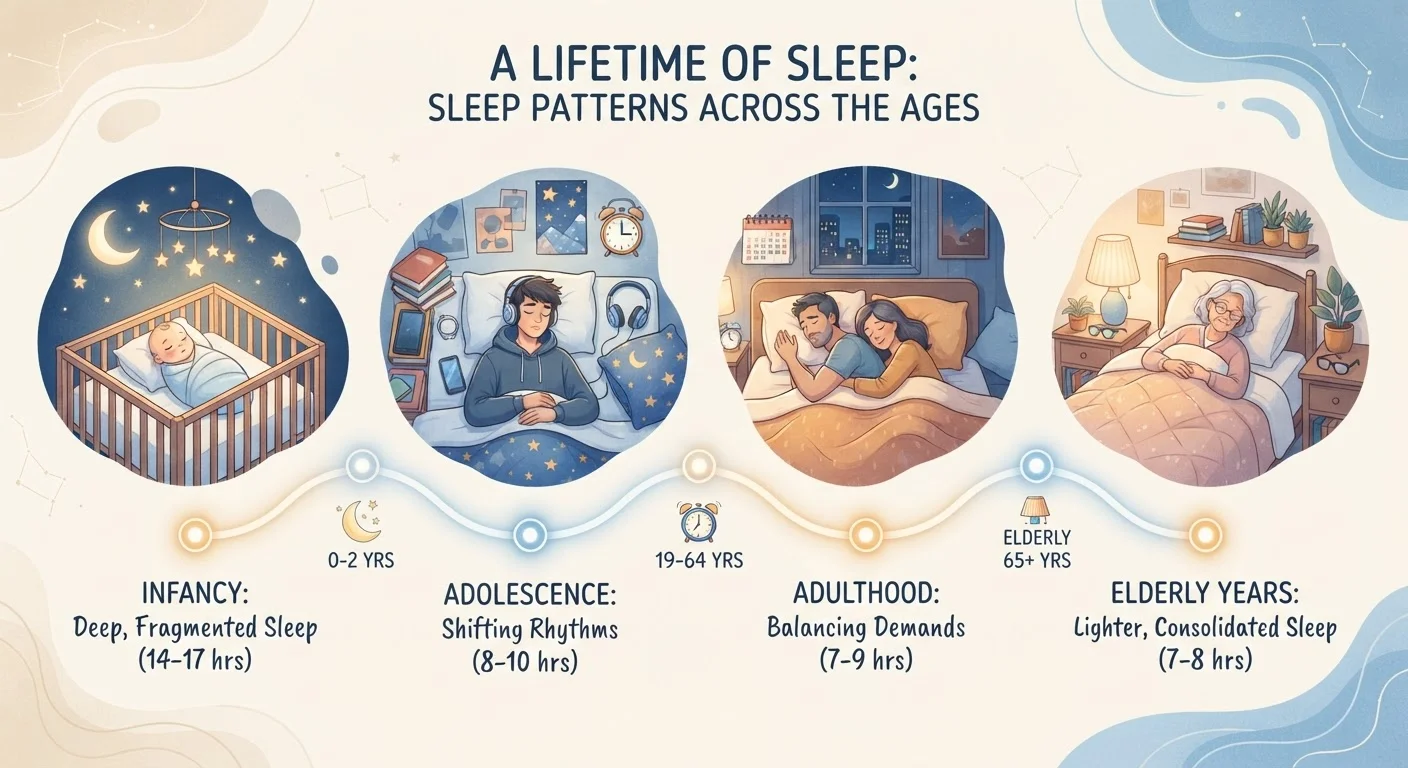
Photo: YetaWellness.com | Explore Trending Blogs editorial
Why Age Is Central to Understanding Sleep Disorders
Sleep disorders are not one-size-fits-all. The conditions most likely to emerge, and the way they present, are shaped significantly by age. A six-year-old experiencing night terrors is in a very different clinical situation than a 65-year-old with the same nocturnal disruptions. Understanding how sleep biology shifts across the lifespan is essential context for making sense of why certain disorders cluster at specific life stages.
Underlying mechanisms — including changes in sleep architecture, circadian rhythm timing, hormonal fluctuations, and neurological development or decline — all influence which disorders are most likely to appear and why. This reference guide maps recognized sleep disorders to the life stages where they most commonly arise, without diagnosing individual readers or replacing professional evaluation.
| Most common pediatric sleep disorder type | Parasomnias (e.g., sleepwalking, night terrors) (American Academy of Sleep Medicine) |
| Estimated OSA prevalence in children | 1–5% (American Academy of Sleep Medicine) |
| Chronic insomnia prevalence in adults | ~10–15% (General epidemiological estimates, Sleep Medicine Reviews) |
| Estimated OSA prevalence in adults over 65 | 30–40%+ (Multiple population-based studies) |
| Peak age range for circadian phase delay disorder | Adolescence to early adulthood (American Academy of Sleep Medicine) |
| Primary OSA risk factor shift by age | Enlarged tonsils (children) → obesity/anatomy (adults) |
Childhood and Adolescence: Development in the Foreground
During childhood, the nervous system is still maturing, and this creates fertile ground for parasomnias — sleep behaviors that emerge out of non-REM or REM sleep. Sleepwalking, sleep talking, confusional arousals, and night terrors are substantially more common in children than in adults. Most are benign and self-resolving, though frequency, safety risk, and daytime impact can warrant clinical attention. For a deeper look, see our article on parasomnias and what triggers them.
Obstructive sleep apnea (OSA) in children is often driven by enlarged tonsils or adenoids rather than obesity, which distinguishes it from adult presentations. Prevalence estimates in children generally range from 1–5%, according to the American Academy of Sleep Medicine. Behavioral insomnia of childhood — where difficulty falling or staying asleep is tied to learned associations or limit-setting — is another common pediatric concern.
Adolescence introduces a distinct shift: a biologically driven delay in circadian timing means teenagers naturally tend toward later sleep and wake times. When school schedules conflict with this phase delay, chronic sleep restriction can result. Circadian rhythm disorders, particularly delayed sleep-wake phase disorder, peak in prevalence during the teen years.
Adulthood: Stress, Hormones, and Emerging Conditions
Insomnia disorder becomes markedly more prevalent in early-to-middle adulthood, often triggered by psychosocial stressors, work demands, or parenting pressures. Research consistently identifies insomnia as one of the most common sleep complaints in adults, with chronic insomnia affecting an estimated 10–15% of the general adult population. The three broad categories of sleep disorders — insomnia, hypersomnia, and parasomnia — all have adult-specific presentations worth understanding.
OSA prevalence rises substantially in middle age, particularly among those with obesity, larger neck circumference, or anatomical risk factors. Hormonal shifts also play a meaningful role: women entering perimenopause and menopause frequently report increased sleep disturbances, including insomnia and OSA — changes tied in part to declining estrogen and progesterone levels. See our overview of hormonal shifts across adulthood for relevant context.
Restless legs syndrome (RLS) and periodic limb movement disorder (PLMD) can emerge in adults of any age but are frequently underrecognized. These conditions are among the reasons sleep disorders often go undiagnosed for years.
Older Adults: Structural Changes and Compounding Factors
In older adults, sleep architecture itself shifts: slow-wave (deep) sleep decreases, sleep becomes more fragmented, and circadian timing often advances — producing earlier sleep onset and earlier waking. These changes are normal features of aging but can increase vulnerability to sleep disorders.
OSA prevalence rises sharply in older populations, with some epidemiological studies estimating rates above 30–40% in adults over 65. REM sleep behavior disorder (RBD) — in which people physically act out vivid dreams — is predominantly seen in older adults and has a recognized association with certain neurodegenerative conditions, making clinical evaluation important when it appears. Insomnia also remains highly prevalent, often layered with chronic pain, medication side effects, and underlying medical conditions.
Understanding how sleep quality affects physical vitality in older adults underscores why addressing these disorders matters beyond comfort alone. Anyone experiencing persistent sleep symptoms — regardless of age — should consult a qualified healthcare provider rather than self-diagnosing.
Parasomnia
A category of sleep disorders involving abnormal behaviors, movements, emotions, or experiences that occur during sleep or transitions between sleep and wakefulness. Examples include sleepwalking and night terrors.
Obstructive Sleep Apnea (OSA)
A disorder characterized by repeated episodes of partial or complete upper airway obstruction during sleep, causing breathing interruptions, oxygen drops, and fragmented sleep.
Circadian Rhythm
The body's internal roughly 24-hour biological clock that regulates sleep-wake timing, hormone release, and other physiological functions. Disruptions to this rhythm can cause recognized sleep disorders.
REM Sleep Behavior Disorder (RBD)
A sleep disorder in which the normal muscle paralysis during REM sleep is absent, allowing individuals to physically act out their dreams. It occurs predominantly in older adults.
Restless Legs Syndrome (RLS)
A neurological condition characterized by uncomfortable sensations in the legs and an irresistible urge to move them, symptoms that typically worsen at rest and in the evening, disrupting sleep onset.
Sleep Architecture
The structured pattern of sleep stages — including light sleep, deep slow-wave sleep, and REM sleep — that cycle throughout a night. Its composition changes with age and is affected by various sleep disorders.
This article is for general informational and educational purposes only and does not constitute medical advice. If you or someone you care for is experiencing sleep problems, consult a licensed healthcare professional for evaluation and guidance.
The content on this site is for informational purposes only and is not a substitute for professional advice. Always consult a qualified professional for guidance specific to your situation.